Five Must-See Places in La Gomera
A laurel forest older than the ice age, a valley of terraces, and basalt cliffs you can only see from the water.
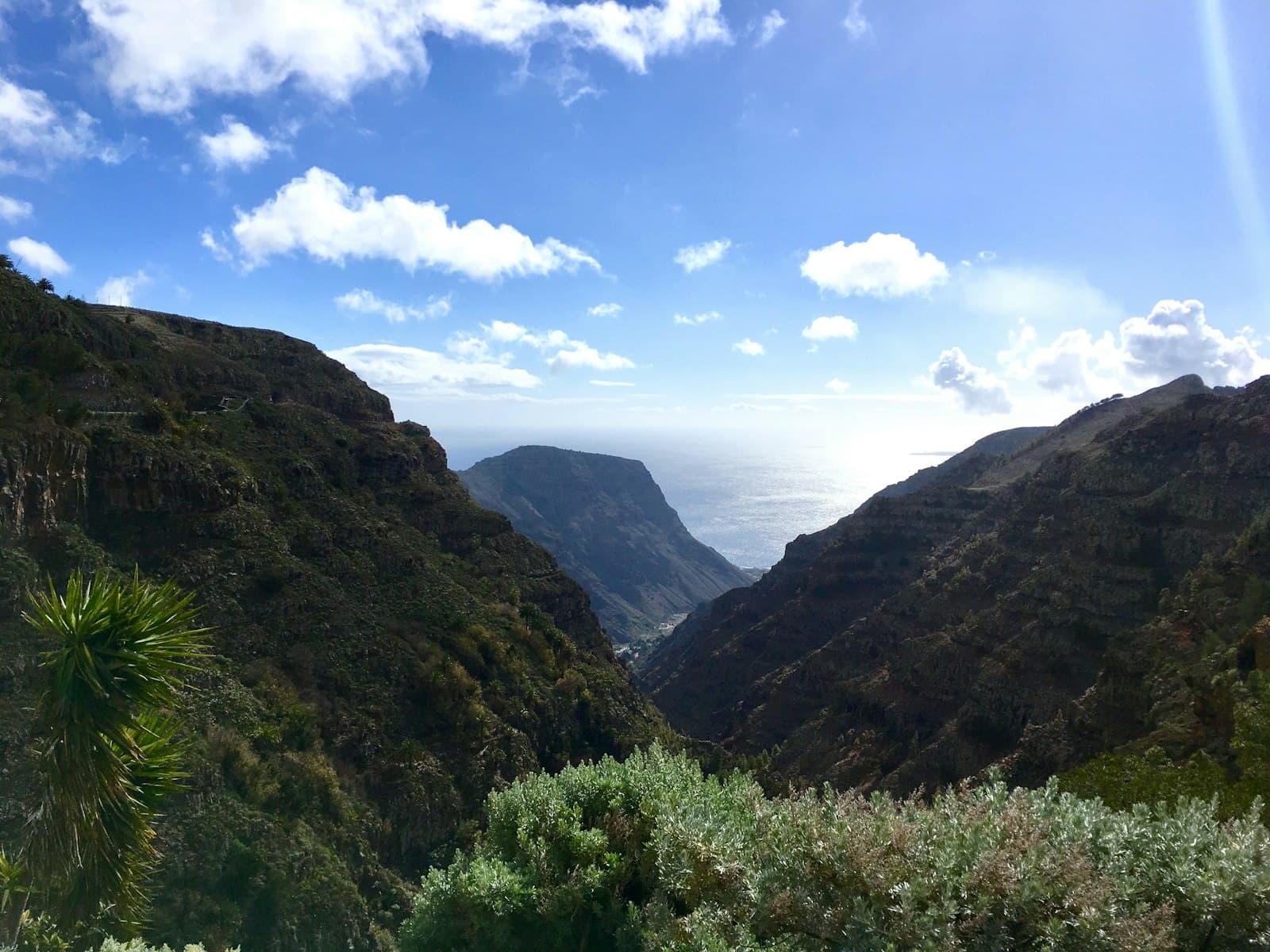
La Gomera is small, round and almost entirely vertical. There is no airport worth speaking of for most visitors, so nearly everyone arrives by ferry from Tenerife, and that single fact keeps it quieter than its neighbour.
Five places that show what the island is. Not a ranking, and not the only five worth the ferry.
1. Garajonay National Park
The reason people come. Garajonay is a laurel forest, and in 1986 it became a UNESCO World Heritage Site because of how much of it survives and how intact it is.
Laurisilva is a subtropical forest that covered much of southern Europe millions of years ago and now hangs on in fragments here, on La Palma, on Tenerife and on Madeira. It lives on the cloud that the trade winds push against the island, which is why it is so often in mist. That mist is the forest feeding, not a spoiled day.
There are marked paths of many lengths, from twenty minutes to most of a day. It is cool and damp up there even when the coast is hot.
2. Valle Gran Rey
A valley on the west coast that opens out into terraces, palms and a couple of small coastal settlements. It has been a destination for a particular kind of visitor since the 1970s and still has that feel.
The drive in is the attraction as much as the arrival. Come in the afternoon if you can: the light runs up the valley from the sea.
3. Los Órganos
A cliff of basalt columns on the north coast, formed when a body of lava cooled slowly and cracked into vertical shafts. It looks like the pipes of an organ, hence the name.
It can only be seen from the water. Boats run from Valle Gran Rey and Playa de Santiago in reasonable conditions. If the sea is up, they do not go, and no amount of planning changes that.
4. The terraces
Not one place, but the thing you will notice most. Almost every reachable slope on this island has been terraced by hand at some point, some of it centuries ago, much of it now unworked.
Drive the road between Hermigua and Agulo and you are looking at an enormous amount of labour, held up by dry stone, slowly going back to scrub. It is worth understanding rather than just photographing.
5. San Sebastián
The port town, and where the ferry lands. Columbus stopped here in 1492 on the way west, which the town mentions.
It is small and unhurried, and it is where you will start and end the day whether you plan to or not. Worth an hour rather than a day.
Getting around
The roads are the constraint. La Gomera is only about 25km across, but the ravines run from the centre to the sea in every direction and the road has to go around or over each one. Journeys take much longer than the distance suggests, and if somebody says an hour, believe them rather than the map.
Ferries run from Los Cristianos on Tenerife and are the practical way in. A day trip is possible but tight: you will see the road more than the island.
In the forest
Garajonay is wet, often inside cloud, and the paths are slippery more days than not. They are also marked for a reason: the moss, ferns and lichen either side of them take years to come back from a boot print.
Fire is the real threat. An arson fire in 2012 burned 742 hectares, just under a fifth of the park, including laurel forest that had stood for a very long time. Restoration work has been going on since. Nothing that burns belongs in there.
The whistle
La Gomera has a whistled language, Silbo Gomero, developed to carry across those same ravines. It is on UNESCO's list of intangible cultural heritage and is taught in the island's schools.
You are unlikely to hear it used in earnest. Demonstrations exist for visitors, and that is a fair way to encounter it, but it is worth knowing it was a practical solution to a real problem rather than a novelty.